EINSTEIN: cytomegalovirus infection monitoring for better patient care
August 26, 2026
Based on a presentation by Dr Zoe Neoh at the BioGrid Symposium and Annual General Meeting on 28 April, 2026.
For patients with blood cancers, infection is a constant concern due to a suppressed immune system. Stem-cell transplant recipients are particularly vulnerable: invasive fungal infections, cytomegalovirus (CMV) reactivation, and bacterial bloodstream infections can all be life-threatening. EINSTEIN — Enhancing INfection Surveillance to Transform Excellence In National cancer care — led by Professor Leon Worth, is a program run by the National Centre for Infections in Cancer (NCIC) at Peter MacCallum Cancer Centre that transforms routine electronic medical record (EMR) data into actionable infection surveillance for high-risk haematological malignancy patients.
EINSTEIN’s partnership with BioGrid Australia is pivotal to its success. BioGrid handles application and data infrastructure, cyber-security liaison, the database design based on a common data model, the ETL process and the rule-based result classification. BioGrid also looks after the requirements and testing documentation, validation of the hospital EMR data extraction, and the preparation of data for the clinician-facing dashboards.
At present, the EINSTEIN program runs across two infection types: fungal (Invasive Fungal Infection Surveillance) and viral (Cytomegalovirus or CMV). Unlike the work being done to track fungal infections in a hospital population, the team looking at detection of CMV in patients is focusing on producing a tool that will help clinicians monitor CMV infections in individual patients using real-time data.

Chasing down a challenging threat using multiple data sources
CMV infection is a recognised complication following allogeneic stem-cell transplant, a procedure which replaces unhealthy bone marrow stem cells with healthy donor stem cells to restore normal blood cell production. Healthy people who contract this common virus are normally asymptomatic, but in an immunocompromised patient it can lead to life-threatening end-organ disease, with significant mortality and healthcare-cost implications.
The ability to effectively monitor infection in allogenic stem cell transplant patients currently requires the manual integration of multiple data sources — viral loads, treatment data, transplant details — together with dynamic risk stratification. This process is labour-intensive and time-consuming. EMR data are unstructured and often fragmented, placing a burden on staff and hindering efficient multi-patient tracking.
The aim of the CMV infection monitoring project is to incorporate clinicians’ insights into the development of an automated system to enhance the CMV monitoring process, resulting in a tool reflecting how clinicians work and what data they need to support their decision-making.
Approach: Stanford Design Thinking Framework
To do this, the team working on the codesign of a CMV infection monitoring portal led by Dr Zoe Neoh adopted the five-stage Stanford design-thinking framework — empathise, define, ideate, prototype and test.
They first established a learning health community, which provided input to help define the problem and observed the existing workflow, including how nurses and clinicians perform CMV monitoring manually, and presented cases during weekly clinical meetings.
Three focus groups involving 17 healthcare professionals across five hospitals then explored pain points and what features they would need for an improved system.
Based on the focus-group findings, the team organised and prioritised user needs and generated actionable problem statements, such as "As a haematologist, I would like to monitor my patient’s viral load over time". Next followed the creation of user personas to define the key user groups and how they would likely interact with the prototype.
User requirements were turned into a design based on feasibility and viability — what could work and what would work — and this informed the initial design of the clinician-facing portal interface. The prototype of the key interface screens was then refined based on feedback gathered from another round of focus-group discussions.
In the final test phase, each participant was asked to interact with the prototype, execute a defined task based on the current workflow, and then complete a System Usability Scale (SUS) survey at the end of the session.
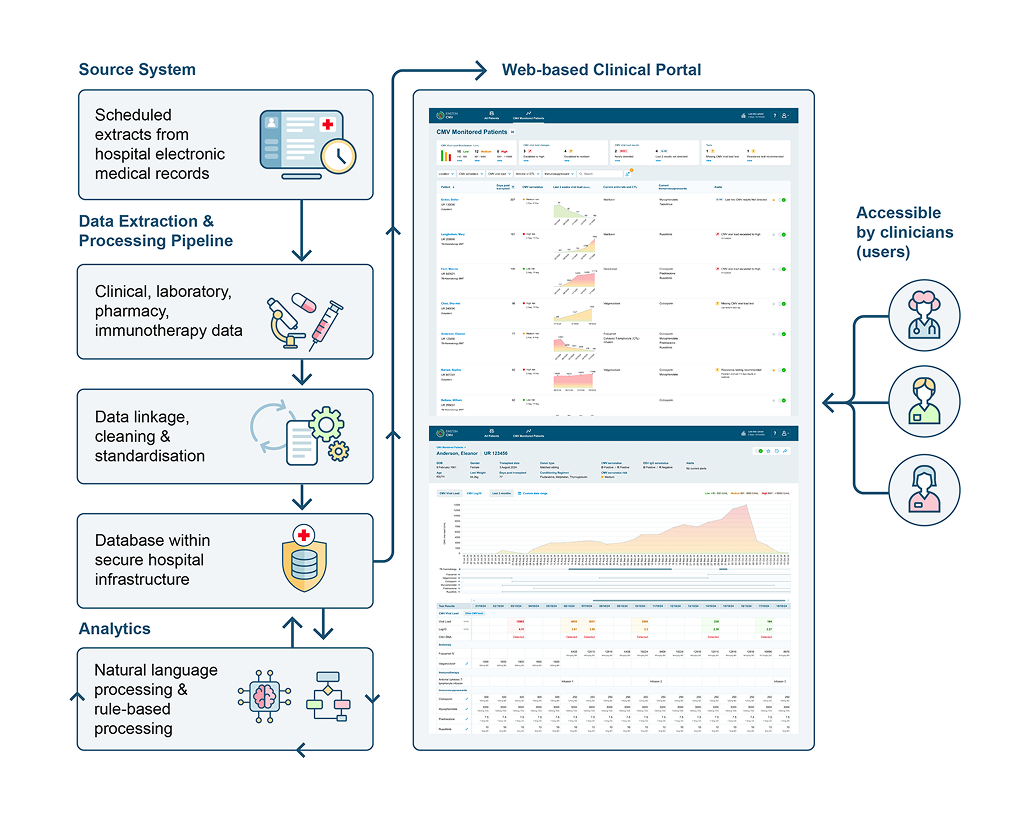
Illustration 1: Overview of how the CMV portal will operate
The CMV infection monitoring portal – a clear path to timely decision making
The clinician-focused CMV infection monitoring portal will have two main components. The first is a patient list of all allogeneic stem-cell transplant patients, automatically loaded from the EMR system. The clinician will manually select the patients they wish to monitor for CMV, which moves the patient into the CMV monitoring list.
The CMV monitoring list shows:
- patient details
- day post-transplant
- CMV serostatus based on donor and recipient (indicated using a traffic-light system — green for low risk, red for high risk)
- current antiviral and CTL treatment received by the patient
- current immunosuppression.
The list will also display alerts that highlight key situations such as a missing CMV test or a viral load that has escalated to a high range. At the top of the screen, all alerts are summarised for quick filtering.
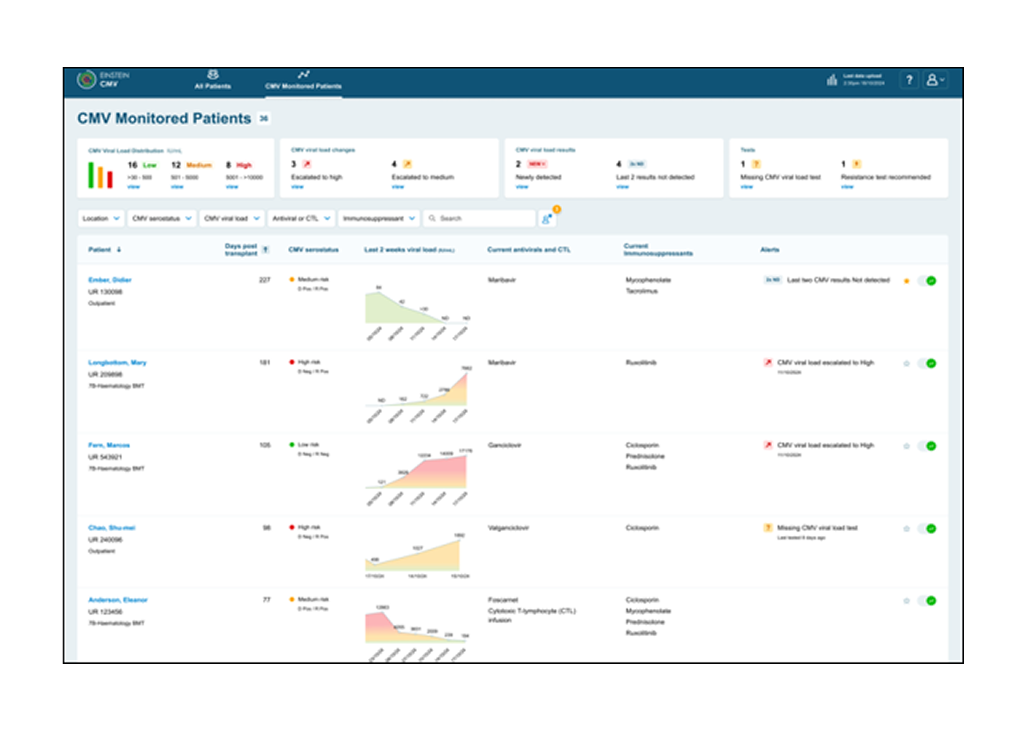
Illustration 2: CMV portal patient list
Individual patient tracking
The second main component is an individual patient monitoring page, which is opened when a clinician clicks on a specific patient in the patient list. Its main feature is a longitudinal viral load graph showing data over up to three months.
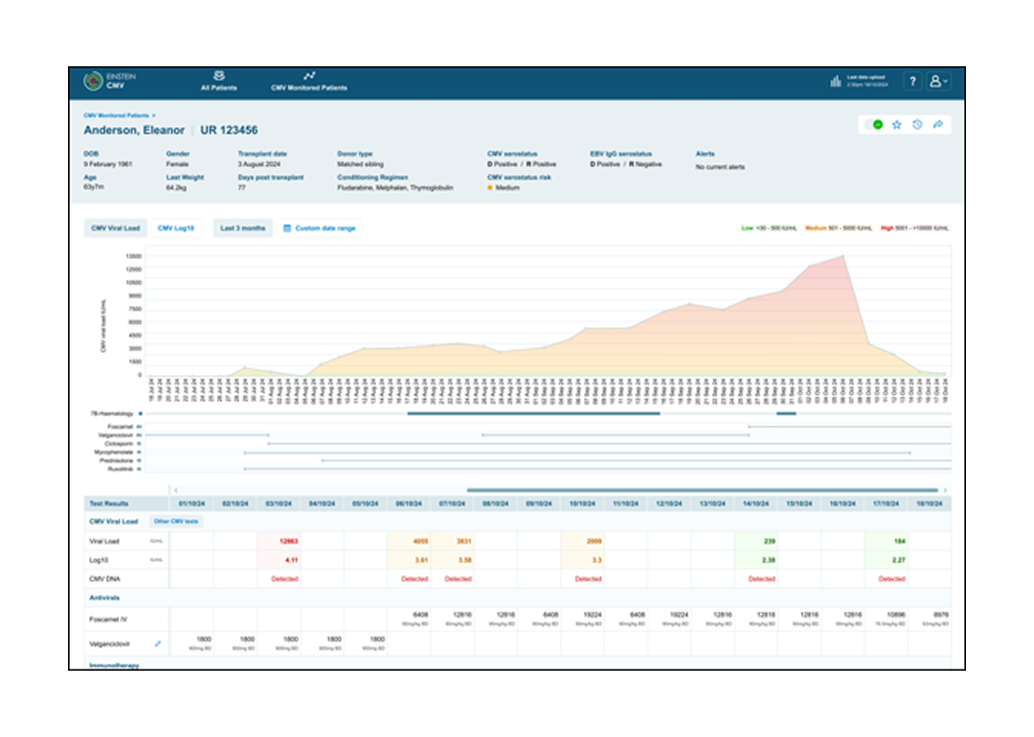
Illustration 3: CMV portal patient monitoring page
Underneath the graph and aligned with the graph’s timeframe are antiviral treatment, immunosuppression and immunotherapy data, allowing clinicians to correlate treatment changes with viral load trends. The portal also surfaces other CMV tests, including resistance testing and histopathology reports; for the latter, a natural language processing (NLP) model is currently being developed to flag CMV disease.
Early on, the feedback is promising
The success of the CMV portal will come down to how usable it is for clinicians, and early testing is showing promising results. The CMV portal received a System Usability Scale (SUS) score of 93.6 among clinicians who participated in the final testing phase — well above the industry average, indicating excellent perceived usability. Participants described the portal as user-friendly and intuitive, indicated they would like to use it in clinical practice, and could see potential clinical and research value.
The portal has great potential to streamline CMV infection monitoring, enable timely intervention and optimise CMV management, which ultimately translates into better patient care.
BioGrid is helping researchers and institutions navigate complexity and move from idea to discovery with greater confidence.
Find out more about BioGrid’s work on the EINSTEIN program.