PURPLE
Pancreatic cancer: Understanding Routine Practice & Lifting End results
Principal investigators
Dr Belinda Lee (Principal Investigator), Peter MacCallum Cancer Centre, Northern Health and the Walter & Eliza Hall Institute of medical research (WEHI)
Sites
56 partnered sites across Australia, New Zealand and Singapore

Pancreatic cancer is one of the most prevalent cancers in Australia; in 2024 it was the eighth most commonly diagnosed cancer in Australia.
It touches many families as the third most common cause of cancer death in Australia, and unfortunately is predicted to become the second leading cause of cancer deaths globally by 2030. It’s a difficult disease to detect and diagnose, as the early symptoms are vague and there are currently no suitably accurate screening mechanisms.
Adjuvant chemotherapy has improved outcomes for pancreatic cancer patients but there are no biomarkers that define whether a patient is more or less likely to benefit from the treatment. Only 1 in 5 patients is suitable for receiving potentially life-saving surgical resection, and about 80% of them will relapse within 2 years. Of patients diagnosed with pancreatic cancer, only about 13% will survive 5 years.
The PURPLE (Pancreatic cancer: Understanding Routine Practice & Lifting End results) registry was developed in 2016 to combat these alarming statistics.
PURPLE is a multi-site, multi-disciplinary translational pancreatic cancer registry platform. It is the first of its kind and aims to increase data sharing and collaboration across cancer centres and research laboratories to accelerate novel research findings from “bench-to-bedside”.
To progress its establishment aims, PURPLE underpins a wide range of translational studies. The registry currently supports tissue and blood-based studies, registry-based clinical trials, and biomarker studies including the DYNAMIC-Pancreas clinical trial and the pancreatic cancer organoid program. These PURPLE translational studies are focused on improving earlier detection methods and supporting the development of more effective therapies for pancreatic cancer.
PURPLE: powered by BioGrid’s unique federated collaboration agreement, data protection and patient confidentiality.
When selecting a partner for the PURPLE program, BioGrid was a logical choice. The researchers already had a longstanding relationship with BioGrid through other research programs, so knew that the company had well-established processes and infrastructure purpose-built for this type of work.
BioGrid’s experience in developing registry software to meet both clinician and researcher requirements was leveraged for the development of the centralised PURPLE registry.
“BioGrid has a good understanding of the need for the de-identification of patient data and the infrastructure to do that, which is a key strength that sets them apart from other developers,” says Dr Lee. “They understand the intricacies of patient confidentiality, as well as the necessary security levels, and can meet these criteria required for hospitals. BioGrid is still the safest partner for the type of work that we do.”
Many Australian hospitals have a relationship with BioGrid through our unique evergreen collaboration agreement, which covers the management of governance, data access, undertaking projects, publications, intellectual property, and commercialisation amongst the collaborators.

Expanding the scope of PURPLE to improve access to clinical trials
In 2025, PURPLE program added a database that consolidated information about all the clinical trials currently being run in Victoria, to enable clinicians to find suitable trials for their patients. This database is currently being expanded to include clinical trials across Australia. Clinicians can access the database through a web portal.

G7 cancer conference “Poor prognosis cancers: from resignation to revolution” in Paris, France, on 26 June 2025
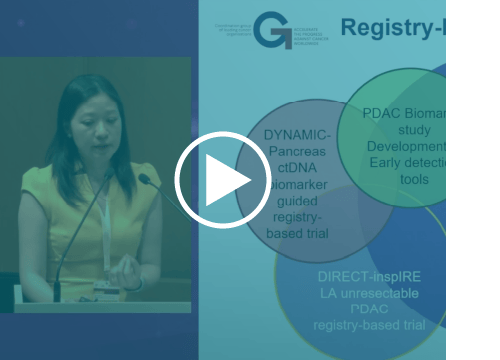
The PURPLE program was invited to represent Australia at the G7 conference, and roundtable meeting to develop a research roadmap for cancers of poor prognosis. Dr Belinda Lee presented the work being done by the PURPLE program to support registry-based clinical trial design for pancreatic cancer.
Watch Dr Belinda Lee’s presentation on “The opportunities and challenges of registry-based clinical trials in Pancreatic Cancer“ at the 2025 G7 conference on “Poor prognosis cancers: from resignation to revolution.”
We hope that by coordinating and linking translational research projects we may be able to better map out the cancer genetics, molecular and cellular mechanisms that lead to treatment response or resistance in pancreatic cancer. The infrastructure provided by the BioGrid platform is integral for this process.”
Dr Belinda Lee, PURPLE Principal Investigator
DYNAMIC-Pancreas clinical trial
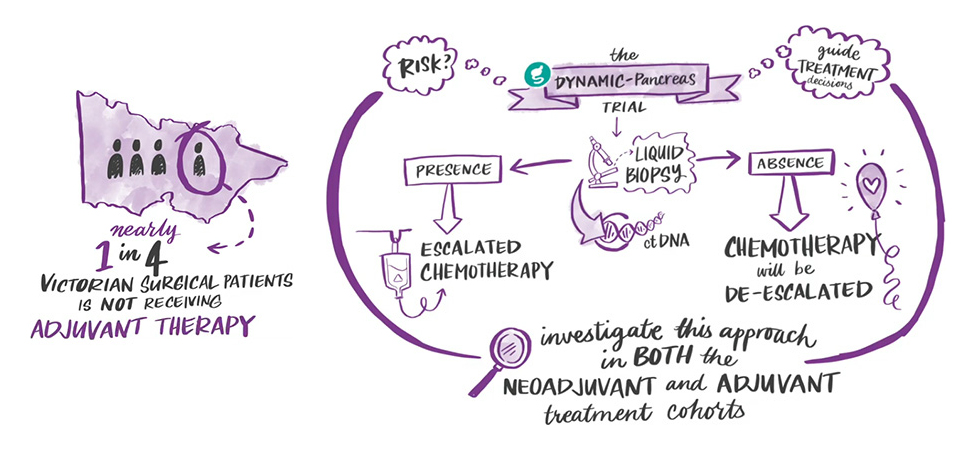
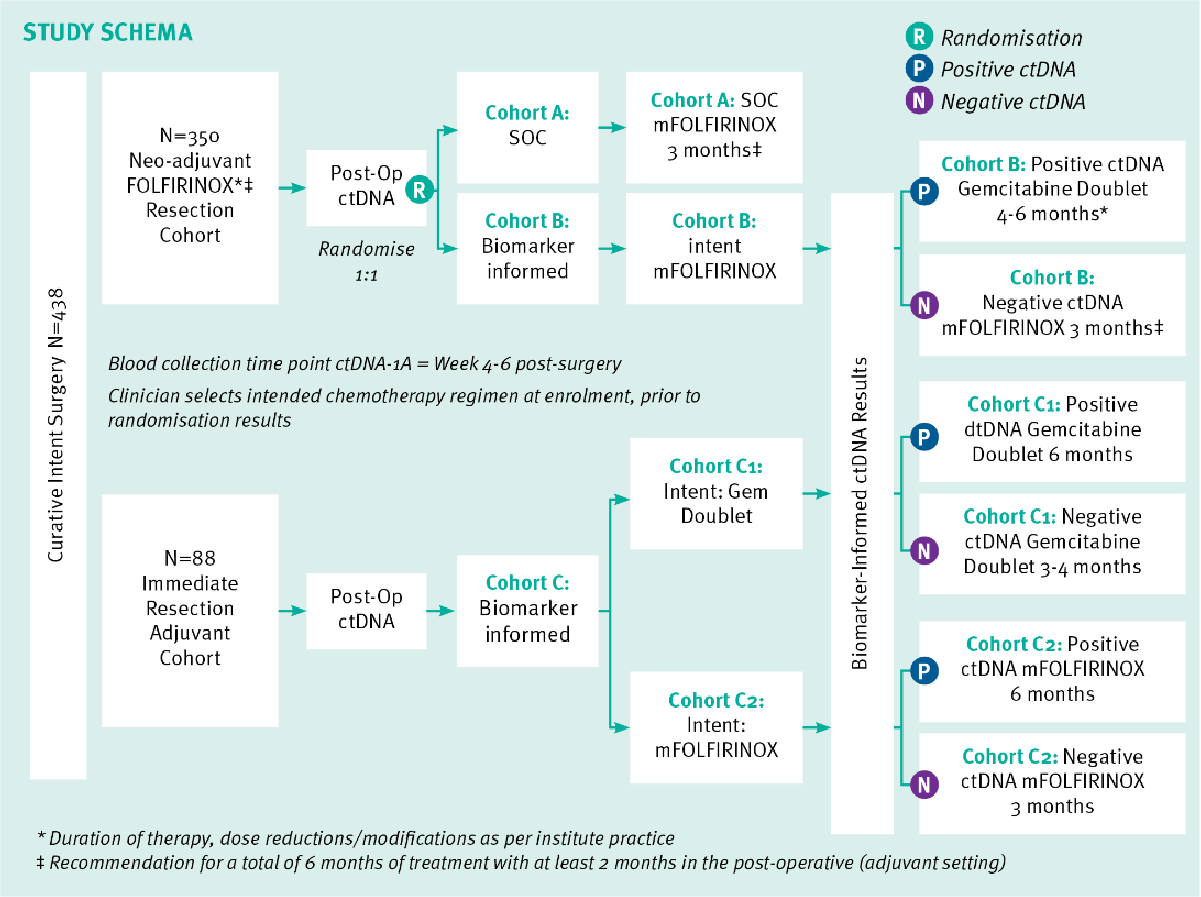
The DYNAMIC (Circulating Tumour DNA Analysis Informing Adjuvant Chemotherapy in Early Stage Pancreatic Cancer: A Multicentre Randomised Study) clinical trial is a prospective, multi-centre, randomised study for patients with localised pancreatic cancer who are undergoing either neoadjuvant (peri-operative) therapy followed by “curative” surgery or immediate “curative” surgery who would routinely be offered adjuvant chemotherapy.
The study will randomise patients who have received neoadjuvant chemotherapy 1:1 into either a non-biomarker-driven, standard of care adjuvant treatment arm (Cohort A) or a ctDNA-informed biomarker-driven adjuvant treatment arm (Cohort B).
The adjuvant chemotherapy treatment of Cohort B participants will be guided by the post-operative ctDNA result of individual participants. Randomisation will occur after the post-operative week 4-6 blood collection and receipt of sufficient tumour tissue for ctDNA analysis.
Patients who did not receive neoadjuvant chemotherapy and instead underwent immediate “curative” surgery will be enrolled into a separate non-randomised biomarker-driven adjuvant treatment group (Cohort C), where the adjuvant chemotherapy treatment will be guided by the post-operative ctDNA results of individual participants.
To view a short video on pancreas cancer care and the DYNAMIC-Pancreas clinical trial, click on the link below:
The pancreatic cancer early detection program
Work by the WEHI researchers led by Dr Lee, in collaboration with the Proteomics Facility at WEHI has discovered a panel of protein markers that can identify pancreatic cancer in patients. Further work is underway to validate these biomarkers to develop non-invasive tests for earlier detection of pancreatic cancer.
The pancreatic cancer organoid program
Pancreatic cancer organoids are derived from the patient’s own tumour stem cell, and can be used for drug screening, genomics, and molecular biology studies.
The results can be used to determine the most suitable and personalised treatment option for each individual patient. The organoid project co-led by Associate Professor Tracy Putoczki, Dr Belinda Lee, and Professor Peter Gibbs currently involves 300 pancreatic cancer patients. Researchers hope to identify new signalling pathways and biomarkers to predict response and optimal drug combinations.
More information

DYNAMIC-Pancreas clinical trial
More information on the DYNAMIC-Pancreas clinical trial can be found on the Australian and New Zealand Clinical Trials Registry (ANZCTR) website at ID ACTRN12618000335291 and the Australasian Gastro-Intestinal Trials Group (AGITG) website.
About PURPLE
For more information about PURPLE go to the Australian and New Zealand Clinical Trials Registry ID ACTRN12617001474347.